South Asia doesn’t suffer from multiple Deep States. That would imply competition, borders, and paperwork. What it has is one Deep State, regionally networked, professionally mobile, and ideologically united by a single belief: democracy is a wonderful idea, provided it never becomes operational.
Its members are easy to spot once you know the species. They are the former generals who are never quite former, the intelligence veterans who discover a passion for think tanks, the bureaucrats who rotate between capitals faster than voters can rotate governments, the NGO professionals fluent in donor dialect, and the foreign “facilitators” who arrive bearing concern, process, and plausible deniability. They don’t need passports so much as LinkedIn recommendations. Dhaka today, Kathmandu tomorrow—same vocabulary, same urgency, same conclusion.
The sales pitch is always stability. The product is always control.
In Bangladesh and Nepal, this single Deep State has been particularly busy—not because these countries are failing, but because they matter. Bangladesh’s offense is competence. Nepal’s crime is geography. One is becoming economically relevant on the Bay of Bengal; the other sits inconveniently between India and China like a strategic speed bump. In both cases, genuine democratic autonomy would be disruptive—to supply chains, to leverage, to the comfortable predictability of managed politics.
The Deep State’s preferred intervention is not the crude coup. That’s old television. This is prestige drama. Institutions are not overthrown; they are outmaneuvered. Elected leaders are not removed; they are surrounded. Power doesn’t disappear; it relocates—into interim arrangements, advisory councils, “national dialogues,” and caretaker formulas that somehow never answer to voters.
And then there is the masterpiece: the public outburst that isn’t quite spontaneous.
Real grievances exist—corruption, inequality, misgovernance. The Deep State doesn’t invent anger; it franchises it. Discontent is identified, amplified, curated. Social media blooms on cue. Civil society discovers urgency. Media leaks arrive pre-chewed. Courts feel the moment. The street becomes the stage, while the real choreography happens off-camera. When institutions wobble, the same hands that nudged them forward step in to “restore calm.” Democracy is declared rescued—by putting it in protective custody.
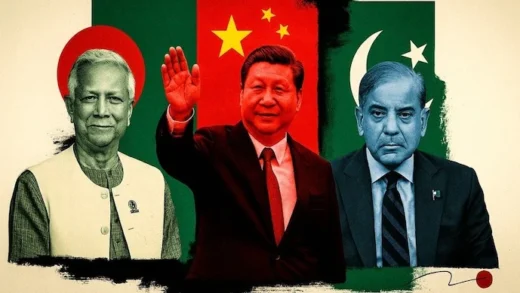
Bangladesh’s version of this drama is slick and calibrated. Economic growth continues, infrastructure rises, and diplomacy becomes a juggling act—China for leverage, Pakistan for symbolism, the West for legitimacy, India for geographic reality. The problem is not balance; it’s who sets the fulcrum. A country that should be consolidating civilian authority instead spends its time managing optics, reassuring neighbors, and proving—again—that stability has not been disturbed.
Nepal’s version is gentler, almost artisanal. Governments rise and fall with monsoon regularity. Reform is perpetually imminent. Non-alignment is performed like interpretive dance. The country remains eternally “in transition,” which is diplomatic shorthand for stuck. The Deep State doesn’t need to rule Nepal; it just needs to ensure no one else rules it decisively either.
China didn’t create this system, but it has become its most enthusiastic accelerant. Beijing prefers dealing with systems over societies, continuity over contestation. Long-term projects and opaque financing thrive when accountability is negotiable. Pakistan serves as the proof-of-concept: a state where the Deep State no longer operates behind the curtain—it owns the theater. Exporting that model, lightly adapted, is tempting to those who see elections as a technical inconvenience.
The United States and other well-meaning powers often play along, mistaking access for influence and order for progress. Stability is praised. Processes are funded. Statements are issued. Meanwhile, accountability is deferred, institutions hollow out, and citizens learn the wrong lesson: that politics is theater and power lives elsewhere.
The goal, of course, is not chaos. Chaos is inefficient. The goal is managed democracy—elections without autonomy, governments without authority, sovereignty without strategy. Flags, anthems, and polling booths are permitted. Steering wheels are optional.
The Deep State insists it is temporary, reluctant, and necessary. It has been saying this for decades. Democracy, it promises, will be returned once it matures—an event perpetually scheduled, never reached, like infrastructure completion dates.
One Deep State. Many capitals. Same playbook. And the same quiet punchline: democracy in South Asia would work just fine—if only voters would stop insisting on using it.
Disclaimer: The term “Deep State” is used here descriptively, not conspiratorially, to denote overlapping institutional interests rather than secret plots or unified control. The behaviors described reflect structural dynamics common in geopolitically sensitive democracies, where domestic elites and external stakeholders often shape outcomes indirectly and incrementally, without formal coordination.