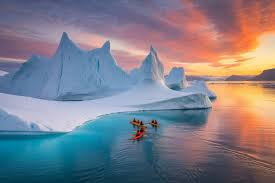
For most of modern history, Greenland existed at the edges of global imagination—vast, frozen, sparsely populated, geopolitically quiet. It was a place of maps rather than headlines, of glaciers rather than power. That era is ending.
Greenland today sits at the intersection of three forces that rarely converge so sharply in one territory: great-power competition, climate transformation, and unresolved questions of sovereignty. What once seemed remote is now central. What once felt irrelevant is now strategic. And what once appeared stable is quietly unsettled.
To understand Greenland’s present—and its future—it is necessary to look beyond the ice.
A colonial inheritance that never fully disappeared
Greenland’s modern political status is rooted in a colonial arrangement that was never fully dismantled. Denmark formally consolidated control over Greenland in the 18th century, and for centuries governed it as a distant possession rather than a partner. Even after Greenland became an integral part of the Danish kingdom in 1953, decision-making power remained overwhelmingly external.
The shift came gradually. Home Rule in 1979, followed by Self-Government in 2009, transferred control over most domestic affairs to Greenlandic authorities. Today, Greenland governs its education, healthcare, fisheries, policing, and natural resources. Denmark retains responsibility for foreign policy, defence, and monetary affairs—along with a substantial annual subsidy that underpins Greenland’s economy.
This arrangement has created a political paradox: Greenland is self-governing, but not sovereign; autonomous, but not independent; strategically vital, but economically dependent. That tension defines almost every debate on the island.
The internal reality: identity, economy, and quiet fragility
Greenland is home to just under 60,000 people, most of them Inuit, spread across a coastline larger than Europe. Its economy is narrow and vulnerable. Fisheries—especially shrimp and halibut—dominate exports. Public employment is extensive. Denmark’s annual block grant accounts for a significant share of government revenue.
Independence, in principle, enjoys broad emotional support. Independence, in practice, raises difficult questions. What replaces Danish funding? How does a small population manage complex state functions? Who guarantees security in an increasingly militarised Arctic?
Climate change complicates these questions further. Melting ice is opening access to mineral resources—rare earths, uranium, iron ore—that could transform Greenland’s economy. But mining projects have triggered deep internal divisions, particularly over environmental damage and foreign ownership. Greenlanders are acutely aware that extracting wealth can also extract control.
There is a growing fear—not always spoken aloud—that Greenland could trade one form of dependency for another.
Why Greenland matters to NATO
From a security perspective, Greenland has always mattered more than its population suggests. During the Cold War, it was a frontline outpost. The United States established Thule Air Base (now Pituffik Space Base) as part of early-warning systems against Soviet missiles. Geography made Greenland indispensable.
That logic has returned—updated, not erased.
Greenland sits astride the GIUK gap (Greenland–Iceland–UK), a critical chokepoint for monitoring naval movement between the Arctic and the Atlantic. As Russia modernises its Arctic military infrastructure and NATO refocuses on northern defence, Greenland’s location has regained centrality.
Denmark’s defence investments in the Arctic have increased, but Copenhagen lacks the capacity to act alone. The United States remains the decisive military actor, and its presence is both welcomed and watched carefully in Nuuk. Greenlanders understand the security benefits—but also remember that past decisions about bases and defence were made without their consent.
NATO, meanwhile, faces a delicate balancing act: strengthening Arctic security without accelerating militarisation that could destabilise the region further.
The United States, China, and the resource question
Few episodes captured Greenland’s new strategic status more starkly than the 2019 revelation that the U.S. president had explored the idea of buying Greenland. The proposal was dismissed as absurd—but it revealed a serious undercurrent: major powers now view Greenland as a strategic asset worth competing over openly.
China has pursued a quieter strategy. Chinese firms have expressed interest in Greenlandic mining projects and infrastructure, framing their involvement as economic partnership rather than strategic expansion. Yet in the current geopolitical climate, economic activity cannot be separated from strategic intent.
For Greenland, this creates a dilemma. Foreign investment is essential for development and diversification. But choosing partners increasingly means choosing sides—whether Greenland wants to or not.
Denmark has intervened more directly in recent years to block or limit foreign involvement in sensitive infrastructure projects, citing security concerns. From Copenhagen’s perspective, this is responsibility. From Nuuk’s perspective, it can feel like constraint.
Climate change: opportunity and existential risk
No place illustrates the contradictions of climate change more starkly than Greenland. Melting ice is unlocking economic opportunity—shipping routes, resources, connectivity. At the same time, it threatens traditional livelihoods, ecosystems, and settlement patterns.
Greenland’s ice sheet is a global climate regulator. Its destabilisation has consequences far beyond the Arctic. Yet for Greenlanders, climate change is not an abstract global problem—it is daily reality.
The world increasingly looks at Greenland as a resource frontier. Greenland increasingly looks at the world and wonders whether it will be protected—or exploited.
The future: independence, integration, or something in between?
Greenland’s long-term trajectory remains unresolved. Full independence is legally possible but economically and strategically complex. Continued association with Denmark offers stability but limits agency. Deeper integration into Western security structures offers protection but risks entanglement.
The most likely future is not a dramatic rupture, but a prolonged negotiation of power—more autonomy, more international presence, more global attention, and more pressure.
Greenland will not choose its importance. That choice has already been made by geography, climate, and geopolitics. What Greenland can still choose is how it navigates that importance—and who speaks for it when decisions are made.
Why Greenland matters to the rest of us
Greenland is no longer a peripheral story. It is a test case for the 21st century: how small societies manage great-power attention; how climate change reshapes sovereignty; how security, resources, and identity collide.
The ice is melting. The silence is gone. Greenland is now part of the world’s central conversation—whether it asked to be or not. And the way that conversation unfolds will say as much about the future of global order as it does about a single island at the top of the world.