
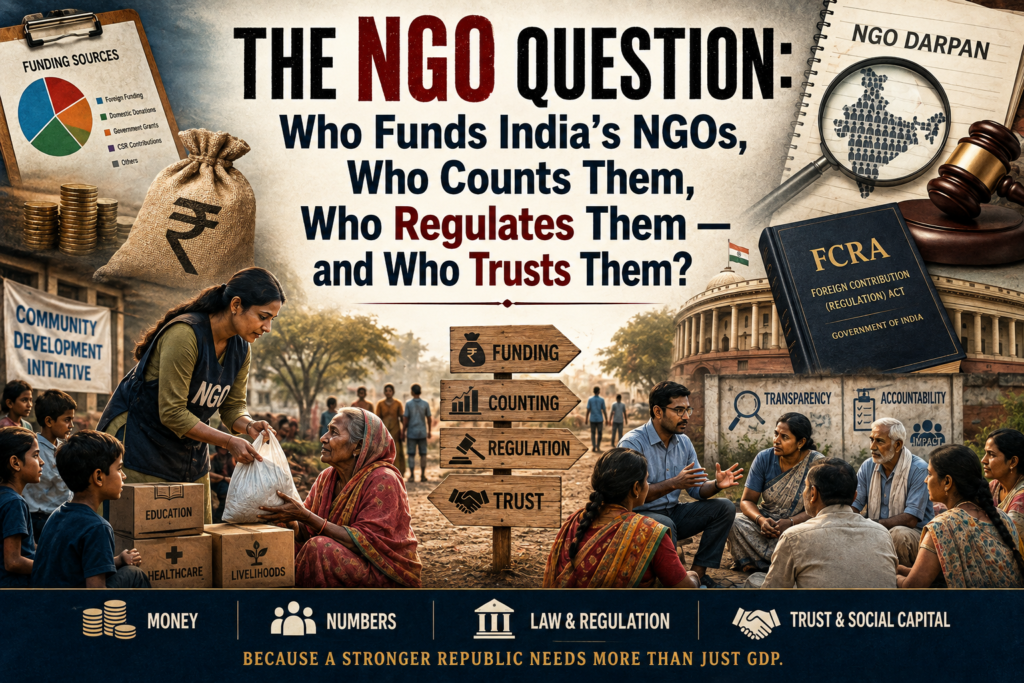
THE MONEY, THE NUMBERS AND THE FCRA QUESTION
India has become remarkably good at counting the parts of its economy that can be formally recorded. It knows how much the country produces, how much it exports, how much tax it collects, how much money moves through its financial system and how much public expenditure is being deployed. It has built enormous digital systems for payments, taxation, identity and government services. Yet somewhere between the formal economy and the millions of communities that make up the Republic sits another vast and complicated ecosystem: trusts, societies, Section 8 companies, charities, religious institutions, foundations, community organisations and voluntary groups working across education, healthcare, livelihoods, disaster relief, social welfare and a hundred other causes. NITI Aayog itself describes the voluntary sector as having a significant role in India’s development and maintains the NGO Darpan platform through its Voluntary Action Cell.
That immediately raises a deceptively simple question: how large is India’s NGO sector? The obvious instinct is to look for one number. But the moment we begin looking at the official systems, the problem becomes more complicated. NGO Darpan is one important administrative database. The Foreign Contribution Regulation Act operates through another regulatory system. Tax authorities maintain their own information. Corporate and CSR frameworks generate another layer of information. Government departments may maintain grant and programme records. These systems can overlap, but they were not necessarily created to describe exactly the same universe of organisations.
NITI Aayog’s current data illustrates both the scale of the sector and the difficulty of interpreting it. Its 2025–26 Annual Report says that more than five lakh NGOs have registered on the NGO Darpan portal. The current Darpan portal separately displays 582,739 Darpan IDs, including 582,654 active IDs and 85 blacklisted IDs, with organisations categorised as trusts, societies and Section 8 companies. These are extraordinary numbers, but they should not casually be presented as a definitive census of every NGO operating in India. Darpan is an administrative registration and information system. It tells us how many organisations have entered that particular system; it does not automatically tell us how many organisations are active, how much work they perform, how much money they handle or how many informal community organisations exist outside it.
That distinction is not a technical footnote. It is the first major finding of the larger investigation into India’s civil society ecosystem. India can count organisations inside particular regulatory and administrative systems, but counting the entire universe of civil society is a different exercise. The question becomes even more important when we ask how many of these organisations are active, how many are dormant, what sectors they work in, where they operate and how their institutional capacity varies. The Government Services Portal itself describes NGO Darpan as an online repository for registered voluntary organisations and NGOs and as a platform through which organisations can obtain a system-generated unique ID.
We explore this data problem in much greater depth at Explain It Clearly, where the investigation asks a deliberately provocative question: Can India Actually Count Its NGOs? The article examines why different administrative datasets can produce different pictures of the country’s civil-society ecosystem and why the number of registered organisations should not automatically be mistaken for the number of active organisations.
But counting organisations is only the beginning. Once we have established that the universe is larger and more complicated than any single number suggests, the next question becomes unavoidable: who pays for all this activity?
That question is much bigger than foreign funding.
India’s civil-society organisations can draw resources from many different channels. Government grants support some programmes. Companies contribute through CSR. Individuals donate. Religious communities mobilise contributions. Philanthropic foundations provide grants. Membership organisations collect fees. Some institutions generate earned income. Others receive foreign contributions under the FCRA framework. An organisation may rely on one source or several. A serious examination of India’s social economy therefore cannot begin and end with foreign money. It has to ask how the entire financial ecosystem works.
That is the question explored by Explain It Clearly in “Who Really Funds India’s NGO Sector? Following the Money Behind the Forgotten Economy.” The investigation follows the funding architecture behind India’s civil-society sector and asks whether public debate has become too concentrated on the foreign-funding component while overlooking the much larger question of how social-sector activity is financed overall.
The foreign-funding question, however, cannot simply be dismissed. It matters because foreign contribution carries legitimate questions of transparency, national interest, accountability and regulatory oversight. That is precisely why India has the Foreign Contribution (Regulation) Act. Under the FCRA framework, organisations covered by the law require the appropriate registration or prior permission to receive foreign contribution, and the regulatory system governs how such contributions are received and used. The government has repeatedly argued that the purpose is to ensure transparency and lawful utilisation of foreign funds.
But the FCRA landscape is changing again in 2026. The Foreign Contribution (Regulation) Amendment Bill, 2026 was introduced in the Lok Sabha on 25 March 2026, while the revised FCRA Rules, 2026 were notified on 22 June 2026 and are already in force. The government says the changes address operational and governance gaps in the existing framework. The Amendment Bill itself remains under consideration by Parliament.
That distinction matters enormously for responsible journalism. The 2026 Bill should not be described as though it were already law. Nor should the revised Rules be treated as merely a proposal. The rules are in force; the amendment bill is still before Parliament. Any discussion of the current FCRA environment therefore has to keep those two stages separate.
The controversy becomes particularly sensitive when the discussion reaches religious and Christian organisations. Churches and Christian bodies have expressed concerns about how the evolving FCRA framework could affect organisations involved in charitable, educational, healthcare and religious activities. Those concerns deserve to be examined seriously, but they should not automatically become the conclusion of the story. The government’s position also deserves to be represented: it argues that foreign contribution requires appropriate scrutiny and that the regulatory framework is intended to ensure that such funds are received, used and accounted for according to Indian law.
That is why Explain It Clearly treated the Christian dimension as a specific question rather than allowing it to become a shorthand for the entire FCRA debate. Its investigation, “Church Concerns on FCRA,” examines the concerns being raised by Christian organisations and places them within the larger question of how India should regulate foreign funding while protecting legitimate religious and charitable activity.
Read the Explain It Clearly investigation: “Church Concerns on FCRA”
The larger issue is therefore more complicated than the familiar political binary. It is entirely legitimate for a democratic state to ask where foreign money comes from, who receives it and how it is used. It is equally legitimate for lawful organisations to expect clear rules, predictable administration and protection against arbitrary treatment. Citizens have an interest in financial transparency. Communities have an interest in access to legitimate charitable and social services. Religious organisations have an interest in being able to conduct lawful religious and charitable activities. A serious FCRA debate has to hold these interests together rather than pretending that one automatically cancels the others.
This is also why transparency and regulation should not be treated as identical concepts. Regulation tells an organisation what it may or may not do under law. Transparency allows citizens and institutions to understand what an organisation is doing. The two can reinforce each other, but they are not the same thing. A highly regulated system can still be opaque. A transparent system can still allow considerable institutional freedom. The real objective should be to create a framework in which legitimate accountability becomes easier without turning civil society into an extension of administrative machinery.
There is another reason the FCRA debate cannot be allowed to swallow the entire NGO question. Foreign-funded organisations are only one component of India’s civil-society ecosystem. A local community group may rely entirely on domestic donations. A religious institution may mobilise volunteers and food during a disaster. A charitable hospital may depend on Indian philanthropy. A women’s collective may operate through member savings. A company may finance a social programme through CSR. A nonprofit may receive a government grant. These activities are part of the social economy whether or not foreign contribution is involved.
The obsession with foreign funding can therefore produce a peculiar distortion. We can become so focused on the origin of one category of money that we fail to ask what the entire ecosystem actually does with its resources.
And that question takes us back to Darpan.
India is not starting from zero. NITI Aayog’s current Darpan system is already a substantial digital layer for the voluntary sector. The 2025–26 Annual Report says Darpan IDs are mandatory for NPOs seeking grants from Union government ministries and departments, and that Darpan IDs are also required for FCRA registration or renewal and certain income-tax exemptions. The report says about 49 central ministries and departments have released grants to NGOs and voluntary organisations through various schemes.
This is important because it changes the question.
The issue is no longer whether India has a digital NGO system.
It does.
The more interesting question is whether the different pieces of India’s civil-society information architecture can eventually become more interoperable.
Imagine an organisation with a verified institutional identity, accessible registration information, clearly identifiable regulatory status, transparent funding information, publicly available programme information and evidence about its work. Imagine a government department being able to discover credible organisations operating in a particular district. Imagine a donor being able to compare institutions without relying entirely on personal recommendations. Imagine a researcher being able to study where civil-society capacity exists and where it is absent.
None of this requires assuming that every NGO is suspicious.
In fact, the logic is almost the opposite.
Better information can strengthen legitimate organisations by making their credibility easier to demonstrate.
But there is an important danger. A system designed to make civil society more transparent could also make it more visible to the State, donors, corporations and other powerful institutions. Transparency can therefore become surveillance if boundaries are poorly designed. The more information a system collects, the more important privacy, access controls, due process and institutional safeguards become.
The goal should not be maximum visibility.
It should be appropriate transparency.
That distinction becomes even more important when dealing with people rather than organisations. Institutional funding, registration and compliance information may legitimately be subject to public scrutiny. That does not mean beneficiaries, volunteers, donors or ordinary community members should automatically become publicly exposed. Transparency should attach primarily to institutions and their public-facing activities; privacy should protect individuals.
This is where the NGO question becomes something much larger than an argument about regulation.
Because once we begin looking carefully at the money, we discover that money is only one part of what civil society creates.
An organisation may receive ₹1 crore and spend ₹1 crore. The financial accounts can record that transaction. But what about the relationships created along the way? What about the volunteers who become connected? The community that begins trusting an institution? The local knowledge accumulated through years of work? The ability to mobilise people during a flood? The relationships connecting a village to a hospital, a government programme or a financial institution?
Those assets rarely appear in conventional financial statements.
Yet they can have enormous practical value.
But following the money still leaves a deeper question unanswered: what happens after the money arrives? Who actually benefits from India’s civil-society ecosystem, who decides which problems deserve attention, and whose voice gets heard when those priorities are set? An organisation can be financially transparent and legally compliant while questions about impact, representation and decision-making remain unresolved. A programme may count thousands of beneficiaries without being able to demonstrate how many experienced lasting change; a donor may fund a legitimate priority without fully knowing whether it reflects the community’s most urgent need; and an organisation may speak on behalf of a community without necessarily giving that community meaningful influence over its own priorities. These questions move the debate from financial accountability to the distribution of social value and institutional power. Explain It Clearly examines this next layer in “The Question Beyond Funding: Who Benefits, Who Decides and Who Gets Heard?”, exploring the gap between activity and impact, the influence of funding priorities, the difference between visibility and representation, and the growing importance of giving beneficiaries a genuine voice. The question ultimately is not whether India’s NGOs are good or bad; it is whether the country can build a civil-society ecosystem in which money is transparent, impact is measurable and people have a meaningful say in decisions that affect them.
A local organisation with a modest budget may be able to mobilise a community faster than a much larger institution that has no local relationships. A women’s collective may create access to information and credit that extends far beyond the money initially contributed. A religious institution may mobilise volunteers and food during a crisis. A community health organisation may succeed because families trust its workers. A nonprofit may become valuable not merely because of what it spends, but because of the network of trust it has accumulated.
This is the point at which India’s NGO question becomes India’s trust question.
And it is the subject of the next investigation in the Explain It Clearly series: “The Trust Economy: Why Social Capital May Be India’s Most Undervalued National Asset.”
The idea is deceptively simple. India has become exceptionally good at measuring money, assets, production and transactions. But a society also depends on things that do not necessarily enter markets: trust, cooperation, volunteering, community networks, institutional credibility and the ability of people to act together.
The financial question therefore leads to a much larger one.
What if India’s civil-society sector is producing an asset that the country has never properly measured?
And if that asset exists, another question follows.
Can India measure social capital without reducing it to a meaningless number?
That is where the investigation moves next—from money and regulation to trust and the forgotten economics of social capital.
FROM TRUST TO TRANSPARENCY: CAN INDIA BUILD A NEW CIVIL-SOCIETY ARCHITECTURE?
The most interesting question about India’s civil-society ecosystem begins where the accounting ends. We can ask how many organisations exist, how much money they receive, where that money comes from and whether they comply with the law. But even after answering all those questions, something fundamental remains unresolved: what value does civil society actually create? A financial statement can tell us how much an organisation spent. A regulatory database can tell us whether it is registered. A programme report can tell us how many people were reached. None of these, by itself, tells us whether a community trusts the organisation, whether people will respond when it calls for help, whether information travels through its network, or whether the relationships built over years can become a source of resilience when a crisis arrives. That is where India’s NGO debate moves beyond regulation and money and into a much larger subject: social capital.
The idea is increasingly recognised internationally. The World Bank’s work on social cohesion treats trust, shared purpose and willingness to cooperate as important elements of societies’ ability to function and withstand shocks. The OECD similarly treats social capital as a multidimensional concept involving personal relationships, social-network support, civic engagement, trust and cooperation. Neither institution suggests that trust automatically produces development, and that distinction matters. Rather, the evidence points toward a more cautious proposition: where people and institutions can cooperate with reasonable confidence that others will behave predictably and fairly, some forms of collective action become easier. For India, with its extraordinary geographical, economic and social diversity, that may be a development asset worth examining much more seriously.
This is the question explored in Explain It Clearly’s investigation, “The Trust Economy: Why Social Capital May Be India’s Most Undervalued National Asset.” The argument is not that an NGO’s financial resources are unimportant. It is that money may be only one layer of what an organisation accumulates. A local organisation may have a relatively modest annual budget but decades of relationships with communities, volunteers, teachers, health workers, local officials and other institutions. Those relationships can allow information to move faster, help identify vulnerable households, make programmes more credible and mobilise people when formal systems alone cannot respond quickly enough.
Read the Explain It Clearly investigation: “THE TRUST ECONOMY”
That distinction becomes particularly important during a crisis. Imagine two communities receiving exactly the same government programme, with the same financial allocation and the same technical design. In one, people already know the local organisation implementing the programme. They trust its workers, understand how to contact them and are accustomed to cooperating. In the other, the implementing institution is technically capable but has little local credibility. The expenditure may be identical. The results may not be. The difference is difficult to capture in a conventional budget because part of the productive capacity lies in the relationships surrounding the programme rather than in the programme itself.
This is why civil society can sometimes function as a bridge between the State and society. Government possesses scale, legal authority and financial capacity. Markets possess capital, innovation and the ability to allocate resources through economic incentives. Communities possess local knowledge and relationships. Civil-society organisations can sometimes connect these different forms of capacity. A nonprofit working in a district may know which communities are difficult to reach, which local leaders are credible, which households are vulnerable and why an otherwise sensible government programme is failing to gain acceptance. Its value may therefore lie partly in what it knows and whom it can reach, rather than simply in what it spends.
But this argument needs an important qualification. Social capital is not automatically good. A tightly connected group can help its members while excluding outsiders. A powerful network can provide jobs and opportunities while also becoming a mechanism of patronage. A community may have strong internal solidarity while having little trust in people outside it. A religious, professional or social organisation can mobilise extraordinary resources among its own members without necessarily creating bridges across communities. The objective, therefore, cannot simply be to maximise the number of relationships. The more important question is what those relationships enable and whether they broaden or restrict access to opportunity, information and institutions.
This is where the distinction between bonding, bridging and linking becomes useful. Bonding relationships create solidarity among people who already share something. Bridging relationships connect people across social, geographic or institutional boundaries. Linking relationships connect communities with institutions that possess greater authority, resources or decision-making power. A women’s self-help group, for example, may begin by creating solidarity among its members. Its social value can become much greater if it subsequently connects those members with banks, government programmes, healthcare institutions, markets and other communities. The organisation is no longer merely helping people within a network; it is helping information and opportunity move between networks.
For a country as diverse as India, that distinction could become fundamental. The country does not merely need strong communities. It needs communities capable of communicating with one another and with institutions. A village organisation that can mobilise its own members is useful. A village organisation that can also connect those members with a district hospital, a government welfare programme, a financial institution and another community may possess a much larger development function. In other words, the strongest civil-society institutions may ultimately be those that create bridges, not simply those that create stronger islands.
That raises an uncomfortable question about how the sector is currently evaluated. Much of development measurement is naturally built around inputs and outputs. How much money was spent? How many people were reached? How many training sessions were conducted? How many houses were built? How many children were enrolled? These measurements are necessary and should not be abandoned. But they can also create a bias toward what is easiest to count. A programme that reaches 10,000 people in one year can appear more successful than an institution that works with 1,000 people while spending years developing a network capable of continuing after the original project ends.
The latter may, in some circumstances, be creating a more durable asset. But durability is difficult to report. A community network does not have a completion certificate. Trust cannot be photographed at the end of a project. Institutional credibility cannot easily be expressed in a beneficiary count. Volunteer capacity can exist for years without being used and then become extraordinarily valuable when a disaster occurs. This creates a fundamental measurement problem: some of the most valuable things civil society produces may be precisely the things conventional project accounting is least equipped to see.
That is why the debate has moved toward measuring social capital and social connection. The OECD has examined ways of measuring personal relationships, social support, civic engagement, trust and cooperation, while acknowledging that there is no universally accepted single definition or measurement system. The World Bank has similarly developed frameworks examining social cohesion, trust, networks and collective action. India does not need to copy these frameworks mechanically. But it can learn from the fact that the international development community is increasingly treating these issues as measurable dimensions of social well-being and institutional capacity rather than as vague philosophical ideas.
This question is examined in greater depth by Explain It Clearly in “Beyond GDP: Should India Start Measuring Social Capital?” The central argument is not that India should abandon GDP. That would be absurd. GDP remains essential for understanding production and economic activity. The argument is that GDP was never designed to measure trust, volunteering, civic participation, community resilience or the quality of relationships between citizens and institutions. A country can therefore experience economic growth while simultaneously experiencing changes in social cohesion that GDP alone cannot reveal.
The practical question is what India would actually measure. One possibility is volunteering: how many people contribute unpaid time, how frequently and through what types of organisations? Another is social-network support: whether people have someone they can rely on during a crisis. Another is civic participation: whether citizens belong to community organisations, participate in local activities or engage in collective problem-solving. Another is institutional trust: whether people believe government agencies, courts, schools, hospitals and other institutions will behave fairly and competently. None of these measures would capture the whole of social capital. Together, however, they could begin making an invisible part of national capacity visible.
There is a danger here too. India should resist the temptation to create a single national “trust score” and pretend that it represents the health of society. Trust is not one thing. A person may trust family members but not strangers, a local organisation but not a distant institution, a religious community but not a government department. A community may possess extremely strong internal relationships while having weak connections to other communities. A national average could conceal precisely the differences policymakers need to understand. Measurement should reveal complexity, not flatten it.
And once we begin measuring the social sector more intelligently, another possibility emerges: better technology.
India already has substantial digital infrastructure for civil-society administration. NGO Darpan provides institutional registration and identification functions, while the FCRA system provides information relevant to foreign-contribution regulation. Government departments maintain grant systems, tax authorities hold information relevant to charitable entities, and corporate CSR operates through its own statutory framework. The pieces already exist. The question is whether they could eventually become part of a more coherent information architecture without erasing the distinct legal purposes for which they were created.
Imagine a legitimate organisation with a verifiable institutional identity, accessible registration status, clearly identifiable regulatory obligations, publicly available information about funding and programmes, and a transparent record of relevant government grants or foreign-contribution status where applicable. Imagine a donor being able to conduct meaningful due diligence without relying entirely on personal contacts. Imagine a government department searching for credible organisations with experience in a particular district. Imagine researchers being able to understand where civil-society capacity is concentrated and where it is missing.
The objective would not be to create a government ranking of “good NGOs” and “bad NGOs.” That would be both dangerous and conceptually flawed. The objective would be to create better information from which citizens, donors, governments, businesses and researchers can make their own judgments. Transparency should reduce the amount of blind trust required to enter a relationship; it should not replace human judgment with an algorithm.
This is the argument developed in Explain It Clearly’s investigation “Could India Build the World’s Most Transparent NGO Ecosystem?” It explores whether technology could connect institutional identity, regulatory status, funding information and programme information in ways that make legitimate organisations easier to understand while preserving their independence.
The phrase “without compromising independence” is critical. A database can make an organisation more transparent, but the same database can potentially make that organisation more visible to powerful institutions than it has ever been before. Transparency can strengthen accountability; uncontrolled visibility can become surveillance. The difference depends on governance. Who can access the information? Which information is public? What is collected? Why is it collected? How long is it retained? Can errors be corrected? What happens when an organisation disputes a classification? What safeguards prevent information collected for one regulatory purpose from being repurposed for another?
These questions matter particularly in a democracy because civil society has a role that goes beyond service delivery. An organisation can work with government and still question government. It can receive a legitimate grant and still criticise a policy. It can represent a community without becoming an arm of the State. A healthy civil-society ecosystem therefore requires a difficult combination: accountability without dependence, transparency without surveillance and partnership without capture.
That principle becomes particularly relevant to the FCRA debate that opened this investigation. The government’s interest in knowing where foreign money comes from and how it is used is legitimate. The concerns of organisations about predictable regulation and the ability to conduct lawful activities are also legitimate questions. The answer cannot be to eliminate regulation, nor can it be to treat every organisation receiving foreign funding as inherently suspect. A mature system should make the facts easier to establish and reduce the political space created by uncertainty.
This is where better data could actually strengthen civil society. If institutional identity, funding information, regulatory status and programme information were more easily accessible and reliable, legitimate organisations would have more opportunities to demonstrate their credibility. Donors would have better information. Government would have better information. Journalists would have better information. Citizens would have better information. And organisations that depend on rumours, opaque structures or unverifiable claims would have less room to operate.
The ultimate objective, however, should not be to create a perfect database. It should be to create a more trustworthy ecosystem.
Trust is partly created by transparency, but it is also created by performance. An organisation earns credibility by keeping promises, managing resources responsibly, treating beneficiaries fairly and remaining present when attention moves elsewhere. Government earns trust by applying rules predictably. Donors earn trust by respecting the autonomy of institutions they support. Businesses earn trust by behaving responsibly toward communities. Technology earns trust when people understand how it works and have meaningful avenues for correction. No database can manufacture these things. It can only make some of the evidence easier to see.
This leads to the largest argument of the entire series. India’s civil society should not be understood simply as a collection of organisations seeking money, complying with regulations or delivering programmes. It is part of the country’s broader institutional capacity. Government provides scale and authority. Markets provide capital and economic incentives. Technology provides connectivity and speed. Communities provide local knowledge and social relationships. Civil society can provide bridges between these systems.
The question, then, is not whether NGOs should replace government. They should not. Nor is it whether the government should simply outsource social development to nonprofits. It should not. The question is whether India can develop a system in which different institutions perform the functions they are best equipped to perform while remaining accountable to one another and to the public.
That is the argument developed in the final investigation at Explain It Clearly, “The Next Republic: Why Civil Society May Become India’s Greatest Development Advantage.” It takes the discussion beyond NGOs and asks whether social capital and civil-society capacity should be regarded as part of India’s broader national development infrastructure.
Seen together, the seven investigations create a progression that is larger than any individual controversy. “Church Concerns on FCRA” examines the concerns of Christian organisations within the foreign-funding debate. “Who Really Funds India’s NGO Sector?” follows the money beyond the FCRA question. “Can India Actually Count Its NGOs?” examines the difficulty of establishing the size of the sector. “The Trust Economy” asks what social value exists beyond financial transactions. “Beyond GDP” asks whether that value can be measured. “Could India Build the World’s Most Transparent NGO Ecosystem?” asks whether technology can improve accountability. And “The Next Republic” asks what all of this means for India’s future institutional architecture.
The sequence matters because it changes the question itself. We begin by asking who receives foreign money. We then ask who receives money more broadly. We ask how many organisations actually exist. We discover that organisations possess relationships as well as budgets. We ask whether those relationships represent social capital. We ask whether social capital can be measured. We ask whether technology can make the ecosystem more transparent. And eventually we arrive at the question that is much larger than the NGO sector:
What kind of Republic does India want to build?
A country can regulate foreign funding. It can create registration systems. It can demand financial disclosures. It can investigate violations. All of these functions are necessary. But the mature objective should be something more ambitious than administrative control. India should aspire to a civil-society ecosystem in which citizens can understand institutions, donors can follow money, regulators can enforce the law, organisations can demonstrate credibility, communities can retain autonomy and legitimate civil society can remain independent enough to question power.
That would require a careful balance. Transparency without surveillance. Accountability without arbitrary control. Regulation without unnecessary uncertainty. Partnership without capture. Technology without replacing judgment. And trust without abandoning scrutiny.
Perhaps that is the real lesson hidden inside India’s NGO debate. The country does not have to choose between a completely unregulated civil society and a completely controlled one. There is a third possibility: a system in which transparency itself becomes a source of institutional confidence. Where the facts are accessible, speculation has less room to grow. Where funding can be traced, suspicion becomes easier to test. Where organisations can demonstrate their institutional history, legitimate credibility becomes easier to establish. Where regulators publish clear information, compliance becomes less mysterious. And where citizens have better information, they become better participants in the ecosystem.
India has already built many of the pieces. NGO Darpan exists. The FCRA information system exists. Corporate CSR reporting exists. Tax and regulatory databases exist. Civil-society organisations exist at extraordinary scale. The missing piece may be the architecture that allows these different forms of information and institutional capacity to work together without compromising the independence of the institutions involved.
That is not merely an administrative challenge. It is a democratic one.
Because civil society is ultimately about the space between the individual and the State. It is where citizens organise, communities cooperate, charities operate, religious institutions serve, volunteers mobilise, philanthropists contribute and organisations challenge or support public institutions. If that space becomes completely opaque, public trust suffers. If it becomes completely controlled, democratic pluralism suffers. The objective must be to make the space more transparent without making it less free.
And perhaps that is why the NGO question deserves much more attention than it normally receives.
The real story is not simply about money coming from abroad.
It is about money, information, institutions, relationships and trust moving through the Republic.
The real challenge is not merely to determine whether India’s civil society is sufficiently regulated.
It is to determine whether India can build a civil-society ecosystem sophisticated enough for a twenty-first-century democracy—one in which institutions are visible enough to be accountable, independent enough to remain credible, connected enough to contribute to national development and trusted enough to bring citizens and institutions closer together.
The final question, therefore, is no longer who funds India’s NGOs?
It is:
Can India build a system in which we can finally understand what its civil society is, where its money goes, what value it creates—and still preserve the freedom that makes civil society worth having in the first place?
Sources & References
- OECD — Guidelines on Measuring Trust
Foundational reference for the article’s treatment of interpersonal trust, institutional trust and social capital. The OECD defines social capital in terms of shared norms, values and understandings that facilitate cooperation and discusses trust as an important indicator of social capital. - OECD — Measuring Social Connectedness in OECD Countries
Used for the discussion of social relationships, community connections and the relationship between social connectedness and well-being and resilience. - OECD — Towards Measuring Social Capital for Place Transformation (2026)
Particularly important for the article’s discussion of measuring social capital through both subjective indicators such as trust and objective indicators such as volunteering, civic participation and association density. The OECD also stresses that national-level averages can conceal important local differences. - World Bank — Trust and Social Inclusion: The Foundations of Jobs and Development
Used for the article’s discussion of trust as “human infrastructure” and the relationship between interpersonal trust, institutional trust, markets, contracts and development. - World Bank — Social Development
Provides the broader institutional context for the World Bank’s work on social cohesion, resilience and trust as part of development. - Indian research on social capital measurement
An Indian study examining an adapted social-capital scale among 1,563 adults in Chandigarh provides additional evidence that dimensions such as neighbourhood connections, trust, volunteerism and social networks can be studied empirically within the Indian context. - Explain It Clearly — “Can India Actually Count Its NGOs?”
The companion investigation examining the difficulty of defining and counting India’s NGO ecosystem. - Explain It Clearly — “Who Really Funds India’s NGO Sector?”
The companion investigation examining the funding architecture of India’s civil-society sector. - Explain It Clearly — “Church Concerns on FCRA”
The companion investigation examining concerns raised by Christian organisations in relation to India’s evolving FCRA framework. - Explain It Clearly — “Beyond GDP: Should India Start Measuring Social Capital?”
The companion investigation extending the Trust Economy argument into the question of alternative measures of national progress. - Explain It Clearly — “Could India Build the World’s Most Transparent NGO Ecosystem?”
The companion investigation examining technology, transparency and institutional accountability. - Explain It Clearly — “The Next Republic: Why Civil Society May Become India’s Greatest Development Advantage”
The concluding investigation in the wider series, examining civil society as part of India’s future institutional and developmental architecture.
Editor’s Note:
This article examines social capital as an analytical concept, not as a claim that trust or community networks automatically produce economic development. The evidence discussed here comes from international institutions and academic research, including the OECD and World Bank, alongside India-specific research. Where studies establish associations rather than causation, the article deliberately avoids presenting those relationships as proof of cause and effect.
The term “Trust Economy” is used as an editorial framework to explore an increasingly important question: whether relationships, civic participation, volunteering, institutional confidence and community networks represent forms of national capacity that conventional economic statistics do not fully capture. The article does not argue that GDP, financial capital or physical infrastructure are unimportant. Rather, it asks whether India’s understanding of national wealth should eventually include a more systematic understanding of the social relationships that allow citizens and institutions to cooperate.
The article also recognises that social capital can have negative as well as positive consequences. Strong networks can create solidarity and resilience, but they can also produce exclusion, patronage or benefits concentrated within particular groups. The relevant question is therefore not simply how much social capital exists, but what kind of social capital exists, whom it includes, what it enables and whether it strengthens cooperation across society.
The purpose of this investigation is ultimately exploratory: if trust is a form of national capacity, should India begin measuring it more seriously? The answer is not predetermined.
— Manish Kumar, Editorial Desk, TheIndiTimes.com