
Alleged by opposing lenders to be linked to Chandra, the five creditors controlled 61.78% of the voting share.
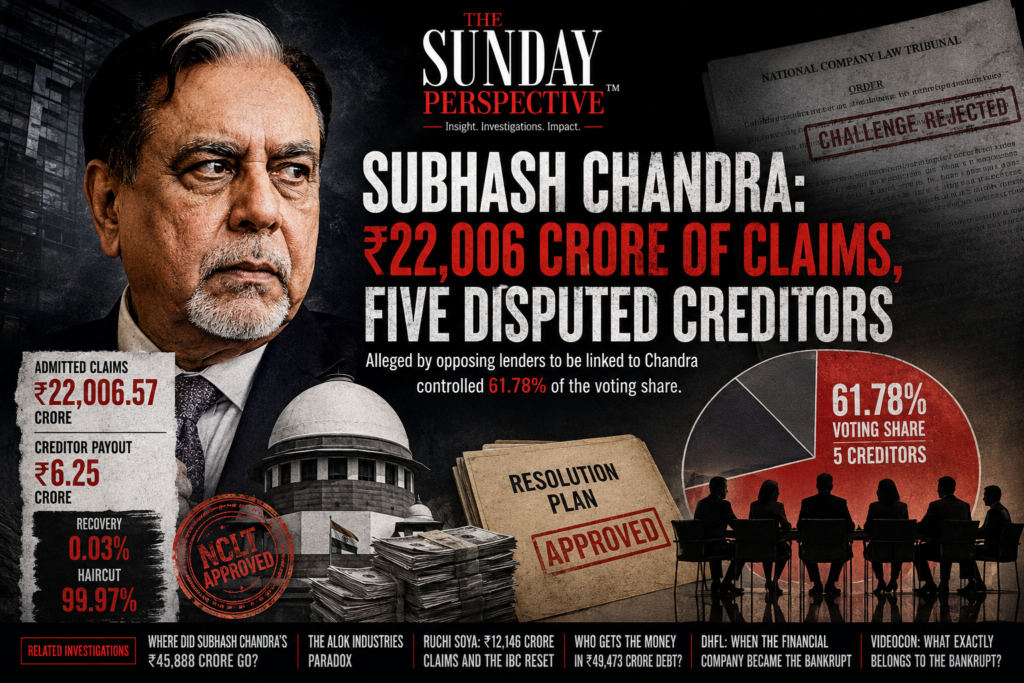
The most revealing number in the Subhash Chandra insolvency case may not be ₹22,006.57 crore. It may be 61.78 percent.
The first number is the scale of the admitted claims against the Essel Group founder in his personal insolvency proceedings. The second is the combined voting share held by five creditors whose eligibility to vote was challenged by opposing lenders. Between them sits a third number that makes the entire case extraordinary: ₹6.25 crore. That is the amount earmarked for creditors under the approved repayment plan, with another ₹25 lakh provided towards the insolvency process.
Put those numbers together and the headline almost writes itself: ₹22,006.57 crore of admitted claims, ₹6.25 crore for creditors, and a decisive voting bloc of 61.78 percent. But the real story is not that a promoter with ₹22,000 crore of claims simply “paid ₹6.25 crore”. Much of the liability arose from personal guarantees and indemnities connected with borrowings by Essel-linked companies. Chandra has maintained that he was a guarantor rather than the direct borrower and has said that the companies for which he gave guarantees had borrowed nearly ₹45,000 crore as of January 2019, of which around ₹43,000 crore had subsequently been repaid. That repayment claim has not been independently verified.
The distinction matters. A personal-guarantor insolvency is not a second corporate insolvency imposed on every company whose borrowing was guaranteed. The underlying borrowers remain separate legal entities. What the process had to determine was what could actually be recovered from Chandra’s own estate against claims arising from those guarantees.
The approved plan says creditors will receive ₹6.25 crore. On the face of the admitted claims, that is roughly 0.03 percent, implying a haircut of about 99.97 percent. It is an extraordinary recovery outcome. Yet the more consequential question may be how the plan obtained the vote required to become binding.
That is where the 61.78 percent enters the story.
Five creditors—World Crest Advisors LLP, Lemonade Capital Advisors LLP, Corpcall Capital Advisors LLP, Veena Investments Pvt. Ltd. and Direct Media Distribution Ventures Pvt. Ltd.—together accounted for 61.78 percent of the voting share and supported the repayment plan. HDFC Bank and other opposing lenders argued that these entities were associates or related parties of Chandra and that their votes should not have counted.
The NCLT did not accept the challenge in the form required to disqualify those votes. That is the legal position arising from the tribunal’s decision. Chandra’s office has also denied the allegation, saying that some of the entities referred to by the objectors belonged to Jawahar Goel and that the family-business interests had been separated in 2008–09. The statutory definition of an “associate” was also disputed.
But the fact that the tribunal rejected the challenge does not make the voting arithmetic unimportant. It makes it more important.
Because these were not five marginal creditors.
They were the bloc that mattered.
World Crest Advisors held 28.49 percent. Lemonade Capital Advisors held 16.85 percent. Corpcall Capital Advisors held 10.30 percent. Veena Investments held 4.99 percent. Direct Media Distribution Ventures held 1.15 percent.
Together: 61.78 percent.
The plan ultimately received support representing 80.814 percent of the votes cast. The arithmetic reveals why the dispute was so consequential. Without the five challenged creditors, the plan’s support would fall from 77.48 percent of the total voting share to just 15.70 percent of the total voting share—nowhere near the statutory threshold required for approval. In other words, whatever conclusion one reaches about the disputed relationships, their votes were not peripheral to the outcome. They were decisive.
That is the central fact this investigation should not allow to disappear beneath the language of “majority approval”.
The banks that opposed the plan were not irrelevant creditors. They simply did not possess the voting weight of the five disputed entities. The opposing lenders collectively had 19.186 percent. HDFC Bank’s share was 3.17 percent; LIC Housing Finance held 6.09 percent; Canara Bank held 1.60 percent. The voting structure therefore produced an unusual inversion: institutional lenders objecting to an exceptionally small recovery could not defeat a plan supported by a much larger bloc whose own eligibility was under challenge.
This is why the case is fundamentally about the architecture of creditor power.
The first question is whether the five entities were legally entitled to vote. The lenders said no. Chandra’s side said the allegation was wrong. The tribunal did not find the statutory case for disqualification established. That question now sits in the legal record.
The second question is different: what were the claims that gave these five entities their voting power, how were those claims created, and how were they verified? That is where the story becomes an investigation rather than a retelling of the NCLT order.
The tribunal record contains material that makes this question impossible to ignore. Objections were raised over the claims of Veena Investments, Direct Media Distribution Ventures, World Crest Advisors, Lemonade Capital Advisors and Corpcall Capital Advisors. The record also contains findings by a tribunal member questioning the verification of certain claims, including claims associated with Lemonade and Corpcall. Those observations should not be converted into an accusation of fabricated debt; they are part of a contested judicial record. But they make the process of claim admission a legitimate subject of scrutiny.
The record also describes the alleged relationships in unusually specific terms. Veena Investments was stated to be controlled by Sushila Devi Goel, the wife of Jawahar Goel, Chandra’s brother. Direct Media Distribution Ventures and World Crest Advisors were described as subsidiaries of Veena. The objections concerning Lemonade and Corpcall pointed to guarantee deeds connected with financing obtained by another group entity, Churu Enterprises LLP, and to relationships involving their partners and companies disclosed as related parties in Veena Investments’ consolidated financial statements.
None of those facts, standing alone, establishes that the entities were legally disqualified from voting. That is precisely why the statutory definition matters. But neither should those relationships be dismissed as irrelevant merely because the tribunal did not ultimately disqualify the votes.
There is a difference between legal disqualification and investigative significance.
The former is a question for the tribunal. The latter is a question for journalism.
The NCLT record also raises a second concern about the integrity of the creditor list. It identified discrepancies in 1,260 individual claims that had been admitted without adequate documentary verification, including claims submitted on behalf of 960 and 300 individuals respectively. The tribunal questioned the absence of documentary evidence supporting those claims and the extent of verification undertaken by the Resolution Professional.
That does not mean all 1,260 claims were fictitious. It means the tribunal record itself raises questions about the adequacy of the verification process. And when an insolvency vote determines whether creditors receive ₹6.25 crore against ₹22,006.57 crore of admitted claims, the quality of the claims admitted into the voting pool becomes more than a procedural detail. It becomes part of the substance of the outcome.
This is the point at which the Subhash Chandra case becomes much larger than a headline about a 99.97 percent haircut.
The IBC relies on a basic bargain. Creditors surrender individual control to a collective process. In return, the collective process is supposed to reflect legitimate creditor interests. Voting power follows admitted financial claims. The majority decides, subject to the Code and judicial oversight. The system works because it assumes that the electorate—the creditors whose votes determine the outcome—is properly constituted.
If the electorate is independent, the model is straightforward: the creditors with the greatest economic exposure exercise the greatest voting power. If some of the decisive voters are alleged to be closely connected to the debtor, the legal system must determine whether those relationships cross the statutory line. That is what happened here.
But the economic question survives the legal one.
When five disputed creditors hold 61.78 percent of the vote, their independence is not a side issue. It is the vote.
That is why the case should not be framed as “Subhash Chandra got a ₹22,000-crore loan waiver”. That description is too crude and legally misleading. The ₹22,006.57 crore represents admitted claims against him in the personal-guarantor process. It does not mean ₹22,006 crore of corporate borrowings were originally borrowed personally by Chandra, nor does the plan by itself extinguish the liabilities of the underlying corporate borrowers.
It should also not be framed as “HDFC lost ₹4,000 crore in the Chandra insolvency”. HDFC’s admitted voting share in this proceeding was 3.17 percent. The much larger numbers belong to the broader Essel-linked debt history. Precision matters because an investigation that exaggerates one figure gives its subjects an easy way to challenge the entire story.
The better question is harder and more interesting: what happened between the enormous corporate borrowings of the Essel era and the tiny recovery available from the personal guarantor’s estate?
Our companion investigation, WHERE DID SUBHASH CHANDRA’S ₹45,888 CRORE GO?, follows that larger debt history. This investigation follows the next layer: who possessed the voting power to decide the final recovery from Chandra personally?
The distinction is crucial. One story traces the money and the debt. The other traces the vote.
And the vote leads to a much larger question about the IBC itself.
India’s insolvency system was designed to replace fragmented creditor action with collective commercial decision-making. The logic is powerful. If every creditor can veto a restructuring because it dislikes the recovery, a company can remain trapped in litigation until the value that might have been rescued disappears. The IBC therefore gives the collective creditor body enormous authority.
But creditor democracy is not democracy in the political sense. Voting power is weighted by financial claims. A creditor with a larger admitted exposure gets a larger vote. That makes economic sense. It also means that the identity and legitimacy of the largest creditors become fundamental to the legitimacy of the decision.
The Subhash Chandra case puts that principle under a particularly bright light because the recovery is so small. Had the plan offered creditors a substantial recovery, the dispute over voting might still have mattered. When the plan offers ₹6.25 crore against ₹22,006.57 crore of admitted claims, the question becomes unavoidable: who decided that this was the best available outcome, and who held the votes that made the decision possible?
The answer, on the present record, is that a creditor majority approved it and the NCLT sanctioned the plan. The five challenged entities were allowed to vote. Chandra’s office denied that they were improperly connected to him. Opposing lenders disagreed and have challenged the outcome.
The story does not require us to decide in advance which side is right.
It requires us to follow the documents.
That means tracing the five entities. It means examining the origin and timing of their claims. It means understanding the guarantees relied upon. It means examining the ownership and control relationships cited by the objectors. It means asking why particular claims were admitted, what documentary evidence supported them and whether the verification process was applied consistently. It means distinguishing a relationship that is legally disqualifying from one that is merely commercially interesting. And it means allowing the tribunal’s reasoning and Chandra’s defence to stand alongside the lenders’ allegations.
That is also why the wider IBC series matters.
In THE ALOK INDUSTRIES PARADOX: RELIANCE, ₹29,523 CRORE OF DEBT AND THE PRICE OF INDIA’S IBC RESET, the question is what happens when a huge debt burden meets a new owner willing to acquire a distressed industrial enterprise.
In RUCHI SOYA: HOW DOES A COMPANY WITH ₹12,146 CRORE OF ADMITTED CLAIMS EMERGE WITH A CLEAN SLATE—AND THEN REACH A ₹33,479-CRORE MARKET CAPITALISATION?, the question is what happens to the old claims when the enterprise itself survives under new ownership and later acquires a dramatically different market value.
In WHO GETS THE MONEY WHEN ₹49,473 CRORE OF DEBT COLLAPSES?, the question is who controls the value left behind when a company fails and the Committee of Creditors decides how that value should be distributed.
In DHFL — WHEN THE FINANCIAL COMPANY BECAME THE BANKRUPT, the problem changes again: what happens when the company entering insolvency is itself a financial intermediary whose balance sheet contains thousands of continuing relationships with borrowers, investors and creditors?
And in VIDEOCON: WHAT EXACTLY BELONGS TO THE BANKRUPT COMPANY?, the fundamental question becomes where the legal boundary of the debtor actually lies when an economic group contains multiple companies, foreign assets and intertwined businesses.
Together, these cases reveal the real experiment underway in India’s insolvency regime. The IBC is not merely deciding how much money creditors get. It is repeatedly deciding what constitutes the debtor, what constitutes the value, who gets to vote and who gets to control the future after failure.
Subhash Chandra’s case adds a particularly uncomfortable question to that list.
What happens when the decisive voting bloc is itself the subject of a dispute over its relationship with the debtor?
The answer cannot simply be “the tribunal decided”. That tells us the legal outcome. It does not eliminate the importance of understanding how the decisive votes were generated.
Nor can the answer simply be “the banks were right”. Their allegations must survive the statutory test and the evidence. Chandra’s denial must be given equal scrutiny. The five entities must be examined on the record, not through assumption.
That is the line between an allegation and an investigation.
And the numbers make the investigation unusually stark.
₹22,006.57 crore: admitted claims.
₹6.25 crore: proposed recovery for creditors.
80.814 percent: votes cast in favour of the plan.
61.78 percent: the combined voting share of the five disputed creditors.
19.186 percent: the combined vote share of the opposing banks and financial institutions.
The first number tells us the scale of the claims. The second tells us the scale of the recovery. The third tells us that the plan won comfortably among the votes counted. The fourth tells us where the decisive power was concentrated.
That fourth number is the reason this story deserves to be investigated beyond the headline.
Because if the five creditors were genuinely independent, then the system did what it was designed to do: creditors with legitimate claims voted according to their economic interests and the majority prevailed.
If the evidence ultimately shows that some of those claims or relationships should have been treated differently, the implications are much larger. It would raise questions about claim verification, voting integrity and whether the IBC’s statutory definitions are sufficiently capable of dealing with complex business networks.
Neither conclusion should be written before the documents establish it.
But the question can—and should—be asked now.
When the fate of ₹22,006 crore of admitted claims is decided by a vote in which five disputed creditors hold 61.78 percent of the power, who, in the end, was really deciding how much India’s lenders would recover?
That is no longer simply a Subhash Chandra question.
It is a question about the integrity of creditor power under India’s IBC.