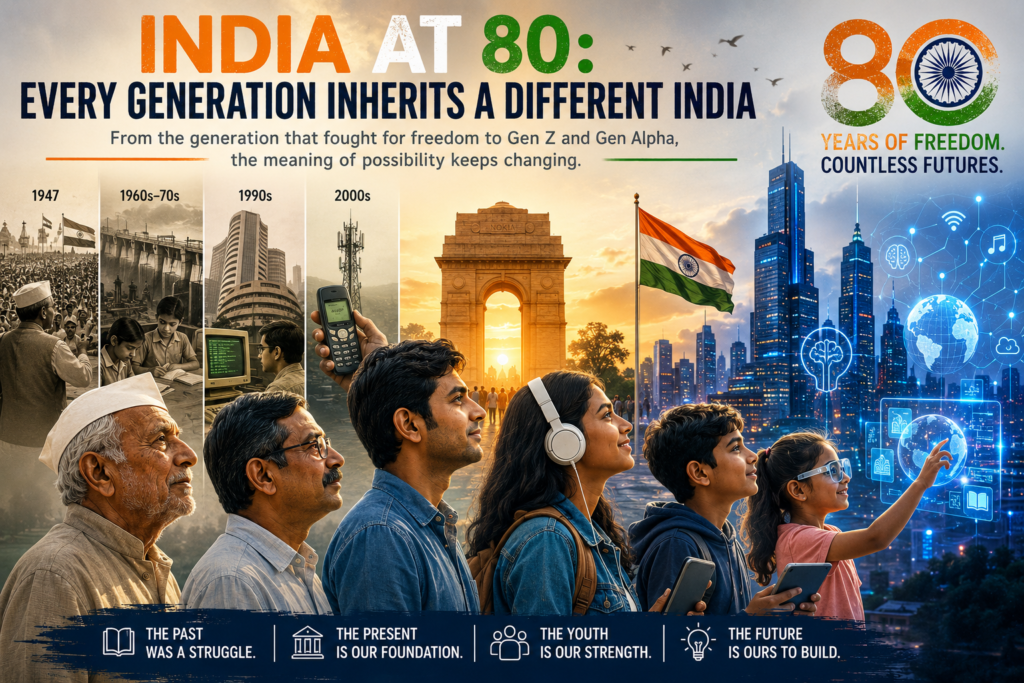
There is something fascinating about listening to four generations of an Indian family talk about the country. The oldest remembers an India in which independence itself was the great dream. The next remembers a country still learning how to build institutions, industries, universities and infrastructure. The generation that came after liberalisation grew up with television, computers, new careers and a country increasingly connected to the global economy. And then came the generation for whom smartphones, digital payments, social media and artificial intelligence are becoming ordinary parts of life. They are all Indian. They share a history. They may even share the same family table. But they did not grow up in the same India.
That may be the most interesting way to look at the country’s 80 years of independence. India has not simply changed from one decade to another. Every generation has inherited a different version of the country. What was once difficult became possible. What was once extraordinary became normal. And what one generation called the future became the everyday life of the next.
For the generation that experienced 1947, freedom was not a metaphor. It was sovereignty. It meant that Indians would determine India’s political destiny rather than have it determined by a colonial power. But independence did not deliver a finished country. It delivered a responsibility. A vast and extraordinarily diverse society had to build democratic institutions, expand education, develop an economy, create infrastructure and prove that democracy could work across enormous differences of language, culture, geography and social circumstance.
The generations that followed inherited that political freedom and began the less dramatic but equally important work of building a country around it. Schools and universities expanded. Scientific institutions were created. Industries developed. Roads, dams, power systems, ports and public institutions slowly transformed the physical and economic landscape. Millions of Indians began to imagine possibilities that had been unavailable to their parents.
Progress, however, rarely announces itself as dramatically to the generation that receives it. The child who grows up with electricity does not think of electricity as a revolution. The child who has always had a telephone does not wonder at the telephone. A young Indian who has never known a world without the internet does not experience connectivity as a historic event. It is simply how the world works.
That is how achievement becomes ordinary.
Then came economic liberalisation, and with it another change in the meaning of possibility. The question increasingly moved from whether India could build to whether Indians could compete. New industries appeared. Private enterprise expanded. Consumer choice multiplied. Information technology became one of India’s great engines of opportunity. Satellite television and later the internet widened the country’s window to the world. A young Indian could begin to imagine a professional life that looked very different from that of their parents.
Then the digital revolution accelerated the process. The computer became the smartphone. The telephone became a camera, classroom, bank, marketplace, entertainment centre and connection to the world. Digital payments changed how millions of Indians transact. Online learning changed access to knowledge. Social media changed how people communicate, organise and consume information.
For the generation that watched these technologies arrive, each represented a transformation. For Gen Z, much of it was simply the environment in which they grew up.
That distinction is important. Gen Z has inherited an India that is more connected, more technologically capable and more globally exposed than the India known by earlier generations. A young Indian can learn from a teacher thousands of kilometres away, follow a creator on another continent, consume Korean entertainment, use an American AI model, make a digital payment through an Indian system and prepare for an Indian examination, sometimes within the same day.
The physical borders of India have not changed. But the psychological map of the young Indian has become much larger.
That creates extraordinary opportunities, but it also creates extraordinary pressure. More information does not automatically mean more certainty. More career choices do not necessarily make choosing a career easier. Technology can create opportunities while simultaneously creating anxiety about whether the skills learned today will remain valuable tomorrow.
The young Indian therefore inherits both possibility and competition.
There is a tendency to speak about Gen Z as though it were one enormous demographic waiting to be decoded. Political parties want to understand it. Businesses want to reach it. Educators want to prepare it. Parents want to guide it. Technology companies want to predict it.
But Gen Z is not one thing.
Some will enter politics. Some will become entrepreneurs. Some will become scientists, doctors, teachers, engineers, artists, civil servants, researchers or skilled professionals. Some will build companies. Some will build communities. Some will be intensely interested in politics. Others will care more about their careers, families or personal ambitions.
That diversity is not a weakness. It is freedom.
Perhaps that is why the question of what Gen Z wants should not begin with ideology. It should begin with something more universal: the desire for a fair chance to build a good life. A meaningful career. Good education. Financial independence. The ability to learn continuously. The freedom to create. The opportunity to move. The ability to change direction when circumstances change. The confidence that technological progress will expand human possibilities rather than simply make competition more intense.
These are not necessarily radical demands. They are the aspirations of people entering adulthood in a rapidly changing economy.
And then there is artificial intelligence.
Older Indians may understandably describe AI as the technology that will transform the future. For people who grew up before computers became commonplace, before the internet became universal and before smartphones put enormous computing power into everyone’s pocket, AI represents another extraordinary technological threshold.
Gen Z encounters it from a different starting point. AI is increasingly something they can use rather than merely something they can imagine. It can help explain a difficult concept, translate information, generate ideas, assist with coding, support research or become a tool for creativity. That does not mean young people automatically understand it, or that every use is wise. It means that the psychological distance between the young person and the technology is smaller.
And Gen Alpha may experience an even greater change.
For many children growing up now, AI will not necessarily arrive as a dramatic technological event. It may be embedded into learning, search, translation, creativity, entertainment and eventually many forms of work.
The technology that seems extraordinary today may become infrastructure for another generation.
That is why the generational conversation about technology is ultimately a conversation about education and agency. If information is everywhere, knowing how to find it becomes less important than knowing how to judge it. If AI can produce answers, asking good questions becomes more valuable. If machines can perform increasingly complex tasks, human judgement becomes more important, not less.
The great challenge may therefore not be teaching young Indians how to compete with machines. It may be teaching them what is worth doing with the machines.
That is also where the meaning of freedom begins to evolve.
For the generation of independence, freedom meant sovereignty. For the generations that built the republic, it meant the opportunity to construct a functioning nation. For the generation shaped by liberalisation, it increasingly meant economic opportunity. For the digital generation, it meant connectivity.
For Gen Z, freedom may increasingly mean agency. The ability to choose what to learn. The ability to build a career. The ability to create. The ability to question. The ability to participate in public life without having to surrender one’s entire identity to a political camp. The ability to remain connected to India’s traditions while engaging confidently with the wider world.
That does not mean young Indians should be detached from politics. Democracy needs politically aware citizens, and the decisions made today will shape their education, employment, environment, technology and economic opportunities for decades.
But nobody owns a generation.
No political party owns Gen Z. No ideology owns it either. A young Indian can support one policy and oppose another. They can admire something a government has achieved and criticise something else. They can change their mind. They can participate in politics, or choose a different form of contribution.
There is no single correct way to serve a country.
India needs young politicians, but it also needs young scientists, teachers, entrepreneurs, doctors, engineers, farmers, artists, researchers, designers and skilled workers. Nation-building happens on political stages, but it also happens in classrooms, laboratories, hospitals, farms, factories, offices and businesses.
That is an important freedom too.
And perhaps the most interesting question about Gen Alpha is not what it wants today. Most of its members are still children. Their political identities and adult aspirations have not yet been formed.
The better question is: What kind of India are we building for the children who will inherit it?
Because the future we discuss today will eventually become their ordinary life.
The AI that seems extraordinary today may be basic infrastructure tomorrow. The digital connectivity that feels transformative today may become assumed. New forms of education and work may emerge that we cannot yet fully describe.
And when that generation becomes responsible for the country, it will not judge our ambitions simply by the language in which we announced them. It will judge them by the possibilities that actually exist.
That is how every generation should think about its responsibility to the next.
The generation of independence gave India sovereignty. The generations that followed built institutions and capabilities. Liberalisation expanded economic possibility. Digitalisation connected Indians to one another and to the world.
Gen Z inherits all of it.
Its responsibility is not to reject that inheritance because it came from another generation. Nor is it to accept every unfinished part of it without question.
It is to build upon it.
We do not honour the people who built our roads by refusing to travel on them. We honour them by extending the road. We do not honour the people who built institutions by treating those institutions as untouchable. We honour them by making them work better for the people who come next.
Perhaps that is the real story of India’s eighty years.
The country did not simply become independent.
It kept changing what independence made possible.
And perhaps the greatest measure of progress is not that the next generation remains permanently impressed by what the previous generation achieved. It is that the next generation can imagine things the previous generation could not.
That is why the question on India’s 80th Independence Day should not only be what India has achieved. It should also be: What have those achievements made possible for the people who come next?
For a deeper exploration of this question — particularly the extraordinary tension between older generations seeing AI as the future and Gen Z increasingly experiencing it as the present — read the companion essay on Explain It Clearly: India at 80: The Generation That Calls AI the Future Has Raised a Generation That Already Lives in It. What Does Freedom Mean to a Generation That Inherited It?
Perhaps the easiest way to understand how dramatically the meaning of “the future” has changed is to imagine four generations sitting around the same family table. Grandfather: “When I was young, we waited for the telephone.” Father: “When I was young, we waited for the internet.” Gen Z: “When I was young, we waited for the next AI update.” Gen Alpha: “You people waited?” Gen Z: “For what?” Gen Alpha: “For the future.” Gen Z: “Oh. We just refresh.”