
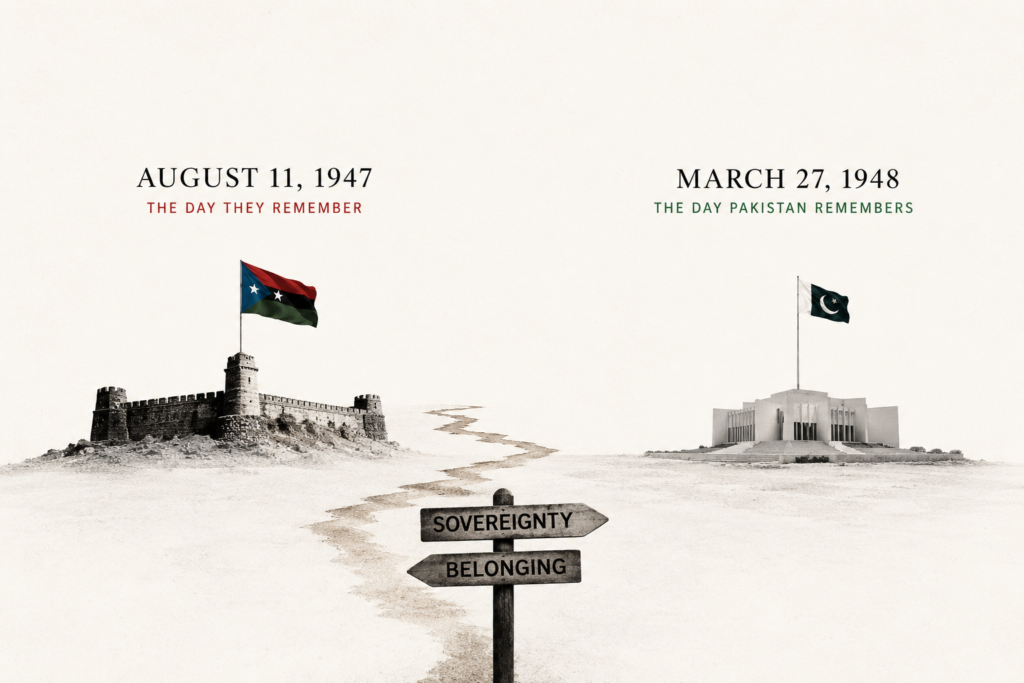
Three days before Pakistan’s Independence Day, the political future of the Khanate of Kalat was being asserted as a question of sovereignty. Months later, Kalat would accede to Pakistan. What happened between those moments remains deeply disputed—and nearly eight decades later, the argument has not disappeared.
That is where our story begins. Not with today’s slogans, not with today’s geopolitical rivalries, and not with the question of whether Balochistan will become independent. It begins with a much older question: what actually happened between August 11, 1947, and March 1948—and why did a constitutional dispute that appeared to have been settled continue to shape Baloch politics for generations?
The question is deceptively simple because the modern map makes the history look far simpler than it was. Today’s Balochistan is a province of Pakistan, but in 1947 the territory that would eventually constitute that province did not exist as one unified political entity. British-administered areas existed alongside the Khanate of Kalat and the princely states of Makran, Kharan and Las Bela. The modern provincial map therefore cannot simply be projected backward onto the political geography of Partition. At the centre of the dispute was Kalat, a princely state whose relationship with the British Empire was sufficiently distinctive to make its political future one of the more unusual constitutional questions left behind by the end of British rule. (Westminster Research)
That distinction is essential because Kalat was not synonymous with today’s Balochistan. Yet the political memory of Kalat eventually became one of the foundations of modern Baloch nationalism. The story therefore contains two histories running simultaneously: the history of a princely state negotiating its constitutional future in 1947, and the later history of a broader Baloch political identity that came to interpret that episode as the loss of an independent future. Confusing the two makes the history easier to tell but less accurate. Keeping them separate makes the story considerably more revealing.
When the Empire Disappeared
The central question emerged from the constitutional vacuum created when British rule ended. The princely states of the subcontinent had not been ordinary British provinces. Their rulers had entered into different forms of treaty and subsidiary relationships with the British Crown, while Britain exercised paramountcy over their external and strategic affairs. When British paramountcy lapsed, the constitutional relationship that had bound those states to the British Crown also disappeared. That did not automatically transform every princely state into a viable modern nation-state, but it created a period of extraordinary uncertainty in which rulers and the new Dominions had to negotiate what would replace the imperial framework.
Kalat entered that uncertain space with a particularly strong sense of its distinctiveness. Mir Ahmad Yar Khan, the Khan of Kalat, believed that the political position of his state was different from that of many other princely states and sought to preserve that position after British withdrawal. Pakistan, meanwhile, had compelling reasons to want a clear settlement. The new Dominion had been born amid Partition violence, enormous population movements, administrative disruption and territorial uncertainty. Its western frontier was not simply a line on a map; it was a strategic question involving communications, defence and the viability of the new state itself. From Islamabad’s perspective, leaving a strategically important territory in an ambiguous constitutional condition was hardly an attractive proposition. From Kalat’s perspective, however, the end of British paramountcy appeared to create precisely the political space in which its separate future could be negotiated.
This was therefore not merely a dispute between a ruler and a government. It was a collision between two conceptions of what the end of empire meant. One began with the question of what sovereignty returned to a princely state when British paramountcy disappeared. The other began with the practical problem of how a newly created country could consolidate its territory and survive in an extraordinarily unstable regional environment. The tension between those two principles would become the first layer of the Balochistan question.
The Agreement That Made August 11 Important
The precise meaning of August 11 is often simplified, but the underlying episode deserves closer attention. On August 4, 1947, representatives of Kalat and Pakistan met in Delhi in the presence of the departing British authorities. A communiqué issued from the Viceroy’s House on August 11 recorded that the Government of Pakistan recognised Kalat as an independent and sovereign state in treaty relations with the British Government, with a status different from that of other Indian states. It also said that legal opinion would be sought on whether agreements concerning areas leased by the British from Kalat would be inherited by Pakistan, while further discussions were to take place on defence, external affairs and communications. A standstill agreement was to operate in the meantime. (Westminster Research)
That document is the historical heart of the August 11 controversy. It explains why Baloch nationalists do not regard the date as a modern invention. The language of the communiqué plainly acknowledged Kalat’s distinctive position, and the planned discussions over defence, foreign relations and communications indicate that the relationship between Kalat and Pakistan had not yet been reduced to a simple, settled accession. At the same time, the document also demonstrates why describing August 11 as the birth of a fully consolidated independent Balochistan requires considerable qualification. The political entity being discussed was the Khanate of Kalat, not the modern province of Balochistan, and the future relationship between Kalat and Pakistan was explicitly left open for further negotiation.
That ambiguity is precisely what makes the episode so consequential. The August 11 communiqué can be read as evidence that Pakistan initially recognised a special and sovereign status for Kalat, while its provisions for subsequent discussions can equally be read as evidence that the ultimate political relationship had not yet been determined. The Baloch nationalist interpretation focuses on the former and sees August 11 as the recognition of an independent Kalat whose sovereignty was subsequently undermined. Pakistan’s historical position places greater emphasis on the constitutional status of princely states, the surrounding political geography and the eventual accession of the Khan. Neither interpretation can erase the existence of the underlying document. What remains disputed is what that document ultimately meant.
And that is why August 11 is more interesting than the slogan attached to it. It is not simply a date on which two sides disagree. It is a date that exposes an unresolved constitutional question at the very moment when the British Empire was disappearing and two new South Asian states were being born.
The Jinnah Connection
There was another complication that makes the story considerably more intriguing. Muhammad Ali Jinnah’s relationship with Kalat predated the creation of Pakistan. He had acted as legal adviser to the Khan, meaning that the relationship between the future founder of Pakistan and the ruler of Kalat was not initially one of a distant nationalist leader confronting an alien political entity. It was shaped by legal advice, constitutional questions and political negotiation. That history makes the later breakdown more significant because the two sides were not strangers to each other’s arguments.
The problem was that 1947 was moving faster than constitutional arrangements could keep up. Jinnah could understand Kalat’s desire to preserve its distinctive position while simultaneously believing that the new Pakistan required a stable territorial and strategic framework. The Khan could recognise Pakistan’s security concerns while maintaining that the end of British paramountcy had created a legitimate opportunity for Kalat to determine its own future. The disagreement was therefore not necessarily born from misunderstanding. It was born from competing interests that became increasingly difficult to reconcile.
For Kalat, the question was whether the end of British paramountcy meant that its relationship with the departing empire had come to an end and whether it could therefore negotiate a new relationship from a position of sovereignty. For Pakistan, the question was whether a newly created state could permit strategically important territories around its western flank to remain politically unsettled. The dispute thus became an early example of a recurring problem in post-colonial state formation: the legal disappearance of an empire does not automatically determine the political shape of what comes after it.
The Problem of Whose Consent Counted
There was another question beneath the constitutional argument, one that would become increasingly important as the years passed: whose consent actually mattered? The question cannot be answered simply by pointing to the Khan, because Kalat’s own political structure contained competing interests, just as the wider Baloch region contained territories with different political arrangements. Nor can it be answered simply by pointing to Pakistan’s supporters, because the mechanisms through which political preferences were expressed did not necessarily encompass every territory and population that later came to constitute Balochistan.
The Government of Balochistan’s own historical account acknowledges the controversy surrounding the June 1947 vote of the Shahi Jirga and non-official members of the Quetta Municipality in favour of joining Pakistan, noting that representatives from Kalat were not included. The same account records objections from Qazi Muhammad Isa, a leading figure of the Balochistan Muslim League, who argued that the vote did not represent the wishes of the people of Kalat or the wider territory claimed by the Khanate. (Scribd)
That does not prove that the population of Balochistan as a whole wanted independence. It would be just as misleading to make that leap as it would be to assume that every political decision supporting Pakistan represented unanimous popular consent. What it does establish is that the political geography and representational mechanisms of 1947 were complicated enough to make the word consent extraordinarily difficult to define.
That difficulty would later become one of the most powerful elements of Baloch nationalist politics. The argument gradually shifted beyond the rights of a ruler and toward the rights of a people. And once that happened, a constitutional dispute about a princely state acquired the ingredients of a modern nationalist question.
When Geography Began to Decide the Argument
While the lawyers and politicians debated constitutional principles, geography was changing the balance of power. The territories surrounding Kalat did not remain frozen during the seven months after Partition. Makran, Kharan and Las Bela followed their own political trajectories and eventually acceded to Pakistan. The Government of Balochistan records the eventual accession of Kalat on March 27, 1948, after a period of negotiations and growing political pressure. (Westminster Research)
This changed the practical meaning of Kalat’s claim. A small state surrounded by territories moving toward a larger neighbouring state could possess a perfectly coherent legal argument and still face an increasingly difficult strategic reality. Independence requires more than a declaration. It requires territory, institutions, revenue, communications, defence and the ability to sustain relations with other states. Kalat was attempting to preserve a princely political structure at precisely the moment when the subcontinent was being reorganised into modern nation-states.
The surrounding accessions therefore mattered not merely because they reduced Kalat’s territorial leverage, but because they changed the strategic environment in which the constitutional argument was being made. The question gradually became less theoretical. Could Kalat realistically remain separate when the territories around it were moving toward Pakistan? Could Pakistan tolerate an independent or semi-independent entity occupying such a strategically important position? And could either side construct a political settlement that would be regarded as legitimate by the populations concerned?
Those questions were never fully answered.
The Seven Months That Changed the Meaning of Partition
This is why the period between August 1947 and March 1948 deserves to be treated as more than an obscure footnote to Partition. It was a concentrated demonstration of the larger problem created by the collapse of empire: political borders can be drawn relatively quickly, but political legitimacy takes much longer to establish.
On August 11, Kalat’s distinctive status was formally acknowledged in a communiqué that envisaged further negotiations. By March 1948, the Khan had acceded to Pakistan. Between those dates came negotiations, shifting territorial alignments, questions over the status of surrounding states and an increasingly difficult strategic environment. The final settlement did not emerge from a vacuum. It emerged from a process in which the balance of political power was changing while the constitutional argument remained unresolved.
The accession itself is not seriously in dispute. The Khan ultimately signed the Instrument of Accession, and Pakistan accepted it. Contemporary Indian records also documented the accession in late March 1948. There are, however, differences in contemporary and later sources over the precise date and details of the final act, with March 27 and March 28 both appearing in documentary accounts. That discrepancy does not alter the central historical fact: Kalat’s attempt to preserve a separate political future ended with accession to Pakistan in March 1948. (Library of Congress Tile)
But the legal fact of accession does not by itself resolve the political meaning of the accession. Pakistan’s interpretation is that the Khan ultimately chose to join the new Dominion and that the resulting incorporation was constitutionally legitimate. Baloch nationalist interpretations place far greater emphasis on the pressure surrounding the decision, the earlier recognition of Kalat’s separate status and the question of whether a ruler’s signature could settle the political future of a much larger population. The two narratives therefore agree on the event while disagreeing fundamentally about what the event meant.
And that distinction is the key to understanding everything that followed.
When the Legal Question Became a Political One
The first rebellion came remarkably quickly. Prince Abdul Karim, the Khan’s younger brother, opposed the accession and launched an armed revolt in July 1948. The uprising was suppressed, but its significance was greater than its immediate military outcome. The constitutional dispute had now crossed a line: what had begun as a disagreement over treaties, sovereignty and accession had become a political and security conflict. The settlement existed on paper, but acceptance of that settlement was not universal.
That is the point at which August 11 acquired a second life. It ceased to be merely a reference to the constitutional status of Kalat in 1947 and gradually became a symbol of an alternative political future—a future that Baloch nationalists would later describe as having been interrupted by accession to Pakistan. That does not establish that an independent modern Balochistan existed on August 11, nor does it establish that today’s Baloch population uniformly supports independence. What it establishes is something more subtle and, ultimately, more important: a political memory was created.
And political memories can survive legal settlements for generations.
The accession answered one question: which state would exercise sovereignty over Kalat? It did not permanently answer another: would the people living in that territory regard the political settlement as legitimate, equitable and their own?
That distinction would become the central fault line of Balochistan’s subsequent history.
The story of August 11, therefore, is not really a story about whether a flag was raised on a particular morning in 1947. It is a story about what happens when an empire disappears, a new state emerges, a constitutional bargain is reached, and yet the argument over sovereignty continues to evolve after the documents have been signed.
The accession settled the territorial question. It did not settle the question of belonging.
The Question Pakistan Never Really Settled
If the accession of Kalat to Pakistan was meant to close the Balochistan question, history soon demonstrated that a legal settlement and a political settlement were not necessarily the same thing. Within months, Prince Abdul Karim, the younger brother of the Khan of Kalat, rebelled against the accession. His revolt was suppressed, but its importance lay less in its immediate military outcome than in what it revealed: the disagreement that had begun as a constitutional argument had already migrated into the realm of political resistance. Over the following decades, Balochistan would experience further periods of insurgency and confrontation, with the demands changing according to the circumstances. At some moments the emphasis was on provincial autonomy and federal rights; at others it centred on political representation, resource control and economic grievances; and among some nationalist organisations, the ultimate demand became complete independence. It would therefore be misleading to describe the entire history as one continuous separatist rebellion. The actors changed, the objectives changed and Pakistan itself changed. What persisted was the recurring question of whether political incorporation had produced political consent. That question is precisely why the history of 1947–48 refuses to remain history.
The deeper problem was that Balochistan’s relationship with Pakistan could never be explained entirely through the original accession. The province occupies an extraordinary position within the Pakistani federation: it is the country’s largest province by area, borders Iran and Afghanistan, stretches along the Arabian Sea and possesses substantial mineral, energy and strategic resources, yet has a relatively small population and has repeatedly experienced a sense of political and economic marginalisation. This creates a paradox that has shaped the province’s modern history. Balochistan is too strategically important for Islamabad to treat as peripheral, but many Baloch nationalists argue that the very importance of the territory has encouraged the centre to approach it primarily through the language of security and resources rather than political representation. Islamabad’s counterargument is that the province has received major investments and development programmes but that instability and militancy have repeatedly obstructed economic progress. The disagreement therefore goes deeper than a simple argument over whether Balochistan has received development. It concerns who controls that development, who benefits from the province’s resources and, ultimately, who gets to decide what the future of the province should look like.
This is where the old constitutional dispute began acquiring an economic dimension. Balochistan possesses important deposits of natural gas and minerals, including copper and gold, while its coastline gives Pakistan strategic access to the Arabian Sea. Yet resource wealth can become politically explosive when the communities living above those resources believe that the benefits flow elsewhere. For Baloch nationalist movements, the argument has often been that the province’s natural wealth is treated as a national asset while local communities remain comparatively deprived and politically weak. The Pakistani state disputes the broader separatist interpretation and points to constitutional mechanisms, revenue arrangements and development programmes intended to integrate Balochistan more fully into the federation. But the persistence of the grievance demonstrates an important political truth: resource distribution is never merely an economic question when it intersects with identity and historical distrust. A gas field, copper mine or infrastructure project can become a symbol of national development to Islamabad and a symbol of dispossession to a nationalist movement at the same time.
That contradiction becomes particularly visible in Gwadar. The port has transformed Balochistan’s strategic importance in ways that would have been almost impossible to imagine in 1947. Located on the Arabian Sea near the mouth of the Gulf of Oman, Gwadar has become a central component of China’s relationship with Pakistan and of the China-Pakistan Economic Corridor, or CPEC. For Islamabad and Beijing, the logic is compelling: infrastructure, connectivity, trade, energy and strategic access can turn geography into economic and geopolitical advantage. But the same project can be interpreted very differently by local communities and Baloch nationalist organisations. If people living around a major port believe that decisions about land, employment, security and investment are being made primarily by distant authorities, then development can become another arena in which the old question of political control is replayed. The argument is therefore not simply whether CPEC is economically useful. It is whether strategic development can produce lasting stability when the population surrounding that development does not feel sufficiently involved in determining its terms.
That is the paradox at the heart of Gwadar. The more strategically valuable Balochistan becomes, the more important local political legitimacy becomes—and the more difficult it becomes for Pakistan or China to treat the province purely as a development corridor. A road can connect markets, but it can also become a military supply route in the eyes of an insurgent movement. A port can generate employment and trade, but it can also provoke fears about land, demographics and who will ultimately benefit from the economic transformation. Chinese investment can be presented as evidence that Balochistan has finally acquired global importance, while separatist organisations can present the same investment as evidence that outsiders are benefiting from resources and strategic geography that belong to the local population. None of these interpretations should simply be accepted as fact; they are competing political narratives. But the existence of those narratives matters because infrastructure does not exist in a political vacuum.
The security consequences have become impossible to ignore. Baloch militant organisations have increasingly targeted Pakistani security forces, infrastructure and Chinese interests, demonstrating that the insurgency is not merely a historical memory but a continuing operational challenge. The March 2025 attack on the Jaffar Express, in which militants seized a passenger train and took hostages before Pakistani forces intervened, brought the conflict dramatically into national and international attention. Subsequent violence has reinforced the perception that the insurgency retains the capacity to strike high-profile targets despite years of Pakistani counter-insurgency operations. For Islamabad, such attacks provide powerful evidence that armed separatist organisations pose a direct threat to the territorial integrity and security of the state. For the militants, attacks are presented as resistance against what they describe as occupation and political repression. The tragedy is that each narrative strengthens the other: militant violence justifies greater security measures, while allegations of excessive state force provide further political material for militant recruitment.
This cycle becomes even more complicated when allegations of enforced disappearances, arbitrary detention and extrajudicial killings enter the debate. Baloch activists and human-rights organisations have repeatedly raised such concerns, while Pakistani authorities have rejected or disputed allegations and emphasised the threat posed by militant organisations. The competing claims are politically consequential regardless of where every individual allegation is ultimately established. A family searching for a missing relative does not experience the issue as an abstract debate about counter-insurgency. For that family, the question is whether the state will acknowledge what happened and provide accountability. When such cases accumulate, they can become part of a collective political memory in much the same way that the Kalat accession became a historical memory. A constitutional dispute from 1947 can therefore be joined by a contemporary grievance, and the two can reinforce each other across generations.
This is why Balochistan should not be reduced to a contest between the Pakistani state and armed separatists. There is a much larger political middle that is often lost when the conflict is viewed exclusively through security headlines. Many citizens may want better schools, hospitals, employment, roads, electricity, political representation and a greater share of the economic benefits generated within the province without necessarily wanting an independent state. Others may favour greater autonomy but not separation. Others may support Pakistan’s territorial integrity while still opposing particular government policies. And some undoubtedly support independence. The absence of a reliable democratic mechanism through which all these positions can be expressed makes it difficult to claim that any single political narrative speaks for all Baloch people. The existence of an insurgency tells us that a serious political grievance exists; it does not, by itself, tell us what the majority of the population wants.
That distinction matters enormously when the word “independence” enters the discussion. There is no credible basis for predicting that Balochistan will inevitably become independent, and the province remains internationally recognised as part of Pakistan. Nor should the persistence of armed resistance be interpreted as evidence that most Baloch people support separatism. But the opposite argument—that because Pakistan’s territorial sovereignty is internationally recognised the political problem therefore does not exist—is equally inadequate. A state can possess unquestioned international sovereignty while facing a persistent internal legitimacy problem. The two propositions are not contradictory. In fact, that distinction is at the heart of Balochistan’s modern history.
India’s position adds another layer to this already complicated picture. New Delhi has previously raised the issue of Balochistan in its public diplomacy, most notably when Prime Minister Narendra Modi referred to the region in his 2016 Independence Day address. Pakistan responded by accusing India of interfering in its internal affairs. But India’s interest in Balochistan cannot be understood solely through the lens of human rights or Pakistan’s internal politics. The province also sits at the intersection of China’s strategic relationship with Pakistan, CPEC, Gwadar and the wider security environment of the Arabian Sea. For India, therefore, Balochistan is simultaneously a political question inside Pakistan and a geographical space within a much larger China-Pakistan strategic equation. Yet this is precisely why India has to be careful. Turning every Baloch grievance into an instrument of India-Pakistan rivalry could actually weaken the credibility of the underlying issue by allowing Islamabad to portray it entirely as an externally manufactured problem.
China faces a different but equally difficult calculation. Beijing’s interest in Balochistan is driven by infrastructure, connectivity and strategic access, but those ambitions increasingly depend on local security and political stability. Chinese citizens and projects have been targeted by Baloch militant organisations, making the security of CPEC an increasingly important concern for Beijing. This creates an unusual situation in which China, despite its preference for dealing with states rather than internal political movements, cannot completely avoid the politics of the territory in which its investments are located. Economic connectivity requires security, but security requires legitimacy; and legitimacy cannot simply be constructed through investment. If local political grievances remain unresolved, additional infrastructure may increase the strategic value of a region without necessarily making the region more politically stable.
The regional geography makes the problem still more complicated. Baloch communities extend beyond Pakistan’s borders into Iran’s Sistan and Baluchestan province and into areas historically connected with Afghanistan. That does not mean that these communities share one political programme, and it would be inaccurate to imagine a single transnational Baloch movement with a unified objective. But the cross-border character of Baloch identity complicates the security calculations of Pakistan and its neighbours. Iran has its own Baloch insurgency and separatist concerns, while Afghanistan’s political instability has historically created opportunities for armed groups and cross-border networks. Pakistan’s allegations of foreign support for Baloch militants therefore exist within a genuinely complicated regional security environment. At the same time, external-support claims cannot automatically explain away domestic political grievances. A movement can receive external assistance and still possess genuine local grievances; these propositions are not mutually exclusive.
And that brings us back to the question with which this story began. In 1947, the central issue was sovereignty: what political status did Kalat possess after British paramountcy ended, and who had the right to determine its future? In the decades that followed, the question became increasingly about autonomy, representation, resources and federalism. For some Baloch nationalist organisations today, it has become a demand for independence. Pakistan, however, regards the territorial question as settled by accession in 1948 and considers the sovereignty of the state non-negotiable. These are not simply two political opinions that can be reconciled by better public relations. They represent fundamentally different understandings of what makes a political settlement legitimate.
The strongest Pakistani argument deserves to be taken seriously. Islamabad can point to the Khan’s eventual signature on the Instrument of Accession, the political decisions of neighbouring rulers, the constitutional context of Partition and the fact that Balochistan has remained part of Pakistan for nearly eight decades. From that perspective, the suggestion that Pakistan simply “annexed an independent country” is an oversimplification of a much more complicated constitutional process. But even if that argument is accepted in full, another question remains stubbornly alive: can a legal settlement permanently resolve a political question if successive generations continue to contest its legitimacy? That is the point at which the historical argument becomes a contemporary political problem.
The Baloch nationalist argument, meanwhile, also deserves to be examined without romanticisation. It is historically understandable that a movement would draw upon the distinctive status claimed by Kalat in 1947 and upon the subsequent history of conflict. But historical memory does not automatically establish a democratic mandate for independence in the present. Nor does armed resistance demonstrate that the majority of a population supports the political objectives of the armed organisations conducting it. If independence is to be presented as a democratic proposition rather than simply a revolutionary one, it ultimately requires the consent of the people who would live under the proposed new state. That is a question that cannot be answered by historical documents alone.
This is why the deepest lesson of Balochistan may lie in the distinction between sovereignty and legitimacy. Pakistan possesses sovereignty over Balochistan. That is an established fact of the international system. But sovereignty does not guarantee that every citizen experiences the state as legitimate, responsive or fair. Conversely, the existence of grievances does not automatically invalidate a state’s sovereignty or establish a right to secede. Between those two propositions lies the difficult territory of politics—the territory in which governments must build institutions, distribute resources, protect citizens, permit dissent and create enough trust that political disagreements do not continually become security crises.
Perhaps that is the real significance of August 11 in 2026. The date does not prove that a modern independent Balochistan existed in 1947. Nor does it prove that independence is inevitable today. What it demonstrates is that the political memory of an alternative settlement has survived the legal settlement that replaced it. Pakistan can point to March 1948 and say that the constitutional question was answered. Baloch nationalists can point back to August 1947 and argue that the question was never answered in a way that settled the issue of consent and belonging. Between those two dates lies not merely a historical dispute but nearly eight decades of political experience.
And perhaps that is why the Balochistan question has proved so resistant to purely military solutions. Armies can suppress insurgencies, but they cannot erase historical memory. Infrastructure can create economic opportunity, but it cannot by itself manufacture political trust. Constitutional provisions can distribute powers, but they cannot guarantee that citizens believe those powers are fairly exercised. Foreign investment can transform geography, but it cannot determine whether the people living on that geography feel that they own the future being built around them. Every one of these problems eventually returns to the same question: who decides, who benefits and who consents?
That is also why Balochistan matters beyond Pakistan. For China, it is a test of whether strategic infrastructure can survive political instability. For India, it is a window into Pakistan’s internal vulnerabilities and China’s growing presence around the Arabian Sea, but also a diplomatic issue that carries risks if handled crudely. For Iran and Afghanistan, it is part of a wider borderland security problem. For Pakistan, it is simultaneously a territorial imperative, an economic challenge and a question of federal legitimacy. And for the Baloch nationalist movement, it remains a struggle over whether the political future of the region should be defined within Pakistan or outside it.
Yet after all the geopolitics, the ports, the minerals, the insurgencies and the strategic calculations, the story ultimately returns to the two dates with which we began. August 11, 1947, represents the moment when Kalat’s distinctive political status appeared to acquire new room for manoeuvre. March 1948 represents the moment when that political experiment ended in accession to Pakistan. Pakistan built its legal and territorial argument around the second date. Baloch nationalist memory built its political argument around the first.
Nearly eighty years later, neither date has disappeared.
Perhaps that is the uncomfortable lesson of Partition. States can settle borders faster than they can settle questions of belonging. A constitutional document can determine who governs a territory; it cannot guarantee that every generation will regard that settlement as legitimate. And when that gap persists for long enough, history stops being merely history. It becomes political memory, then grievance, then identity, and sometimes—when every other channel appears exhausted—conflict.
Pakistan does not recognise August 11 as Balochistan’s Independence Day, and there is no international recognition of an independent Balochistan. Those are realities. But there is another reality that cannot be dismissed simply by repeating them: August 11 continues to matter to a political movement precisely because it represents a question that the accession of 1948 did not permanently extinguish.
The question is not whether Balochistan is independent. It is not.
The question is not whether independence is inevitable. It is not.
The question is more uncomfortable: if the Balochistan question was legally settled in 1948, why has the argument over sovereignty, autonomy, resources, representation and belonging survived for nearly eight decades?
Perhaps the answer is that Pakistan won the argument over territory in 1948, but the argument over legitimacy never truly ended.
And every August 11, it returns.