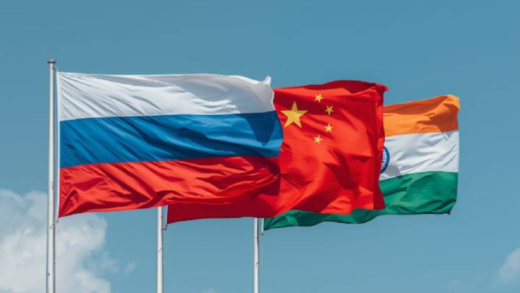
In a breakthrough widely celebrated across global capitals, world leaders proudly announced a new deal this week designed to address the unintended consequences of the previous deal, which itself had been crafted to resolve the fallout of an earlier deal that experts now agree was “prematurely successful.” Officials confirmed the latest agreement would stabilize the situation just long enough for it to become unstable again, at which point a fresh deal—already in “advanced early discussions”—would be introduced to maintain continuity. “This is how progress works,” one senior diplomat explained, moments before scheduling a follow-up summit to fix what this deal is expected to achieve.
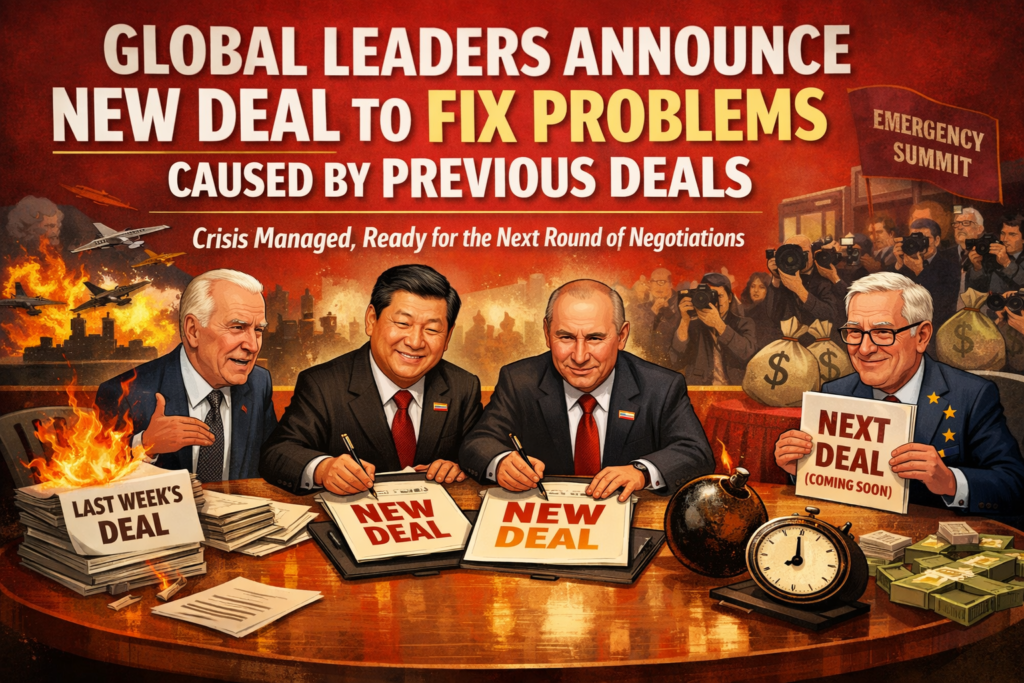
There was a time when the word deal meant closure.
Now it means scheduling the next problem.
Welcome to the Age of Infinite Deals
We no longer solve crises. We cycle through deals.
There’s a deal to stop a war—which works beautifully until the next deal to manage the same war becomes necessary. That, in turn, creates the need for a deal to restart negotiations, which collapses just in time for a deal to de-escalate tensions nobody successfully escalated or de-escalated in the first place.
And when that inevitably fails?
Don’t worry. There’s always a fresh deal to contain the fallout of the previous deal.
It’s not diplomacy anymore.
It’s subscription-based conflict management.
The Trade Deal: Where Math Goes to Die
Then comes the trade deal—that extraordinary invention where every country announces victory, every leader claims toughness, and absolutely nothing fundamental changes except the PDF formatting.
Tariffs are removed, reintroduced, renamed, offset, bypassed, and then heroically “resolved” in the next round of talks. Supply chains are “restructured,” which usually means they now take a longer route with better PR.
The same goods move.
The same money flows.
The same dependencies exist.
But now there’s a press conference.
And that’s what makes it a deal.
Deals That End Wars (For 72 Hours)
Nothing is more impressive than a deal to end a war.
The choreography is flawless. Leaders gather. Statements are read. Words like historic, irreversible, and lasting peace are deployed with the confidence of people who will not be held accountable 10 days later.
For a brief, shining moment, the world believes something has shifted.
And then, like clockwork, the war resumes—slightly rebranded, slightly repositioned, but fundamentally unchanged.
Because the deal didn’t end the war.
It paused the optics.
Deals That Start Wars (But Don’t Call Them That)
Of course, we never sign deals to start wars. That would be too honest.
Instead, we have:
- Security arrangements
- Strategic understandings
- Necessary deterrence frameworks
Which is a very elegant way of saying: we’ve just signed something that makes conflict more likely, but with excellent vocabulary.
And when escalation follows, everyone is surprised. Deeply concerned. Ready to propose…
another deal.
The Ceasefire Carousel
Perhaps the finest achievement of modern diplomacy is the ceasefire deal.
A masterpiece of temporary calm.
It lasts just long enough to:
- Issue statements
- Claim moral high ground
- Reset media cycles
And then—almost artistically—it collapses.
Not completely. Just enough to justify a new ceasefire deal, slightly revised, slightly reworded, and presented as progress.
It’s not failure.
It’s iteration.
Deals About Deals About Deals
We have now entered a higher stage of evolution.
We don’t just have deals.
We have:
- Deals to renegotiate previous deals
- Deals to define the framework for future deals
- Annexures to deals that require separate deals to interpret
- Side deals to reassure stakeholders about the main deal
At this point, the original issue is almost irrelevant.
The ecosystem of deals around it is far more complex—and far more important.
The Nobel Prize for Best Deal Performance
And when a deal is particularly well-performed—when the timing is right, the optics are flawless, and the language is sufficiently grand—it may even qualify for a peace prize.
Not because peace has been achieved.
But because the idea of peace has been convincingly presented.
In today’s world, that’s close enough.
What a Deal Actually Does Now
Let’s be honest about what a modern deal is designed to do.
It does not:
- End conflicts
- Resolve contradictions
- Eliminate underlying tensions
What it does is far more efficient:
- It buys time
- It manages perception
- It creates political breathing room
- It resets expectations without changing reality
A deal is not a solution.
It is a narrative upgrade.
The Final Irony
The most fascinating part?
Everyone knows this.
Leaders know it. Markets know it. Analysts know it. Even the public, somewhere beneath the fatigue, knows it.
And yet, the moment a deal is announced, the ritual continues:
- Headlines soften
- Markets react
- Statements are welcomed
Because we don’t actually expect deals to work anymore.
We expect them to exist.
So the next time you hear that a deal has been reached—on trade, on war, on peace, on anything at all—don’t ask what has changed.
Ask what has been postponed.
Because in the age of infinite deals, the real achievement is no longer resolution.
It’s the ability to keep everything going…
while convincingly announcing that something has been done.